What the game really offers in terms of gameplay
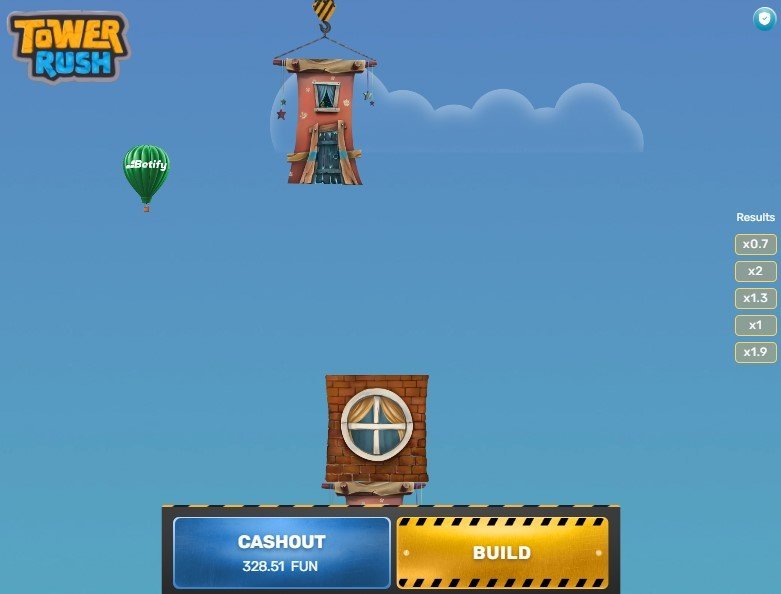
The principle is clear. You set your bet between €0.01 and €100, hit the BUILD button, and the first block descends. The lateral movement of the block accelerates as you go up the floors. The first five are almost free. From the eighth or ninth floor, you need to start focusing seriously.
The CASHOUT button is always accessible. It's the crux of the game: knowing when to cash out. Too early, and you leave money on the table. Too late... well, you start over from scratch.
The difficulty progresses quite naturally. The first floors serve as a warm-up zone, the blocks move slowly, and the margin for error is wide. Around the 12th–15th floor, the pace changes. The blocks move faster, the click window shrinks, and most players crack at this stage.
One point that surprised me: the game does not offer auto-play. Each round requires manual action. This prevents playing on autopilot, which is probably a good thing given how quickly the rounds go by.
How the bonus system works
There are three bonuses in Tower Rush, and they appear randomly during the game. You don't choose them, you don't buy them. They drop when they drop.
The Frozen Floor freezes the multiplier reached. In practical terms, if the bonus triggers on the 8th floor and you miss the 9th, you keep the winnings from the 8th instead of losing everything. It's a kind of one-time safety net, but impossible to anticipate.
The Temple Floor activates a bonus multiplier wheel. A bonus within a bonus, so to speak. The multiplier obtained from the wheel adds to the one already accumulated. When it drops beyond the 10th floor, the difference in the final win is immediately noticeable.
And the Triple Build places three blocks at once, without player intervention. Three free floors, three added multipliers. On paper, the most interesting of the three. In practice, the rarest as well.
These bonuses do not change the overall RTP of the game. They add variance and pace, but the redistribution remains the same in the long run.
| Bonus | Effect | Observed frequency | Best moment |
|---|---|---|---|
| Frozen Floor | Freezes the reached multiplier | ~1 time / 10 rounds | After the 8th floor |
| Temple Floor | Bonus multiplier wheel | ~1 time / 12 rounds | Beyond the 10th floor |
| Triple Build | Automatically places 3 blocks | ~1 time / 15–20 rounds | Critical Zone (10th–15th) |
Tower Rush in demo mode: try it without spending a dime
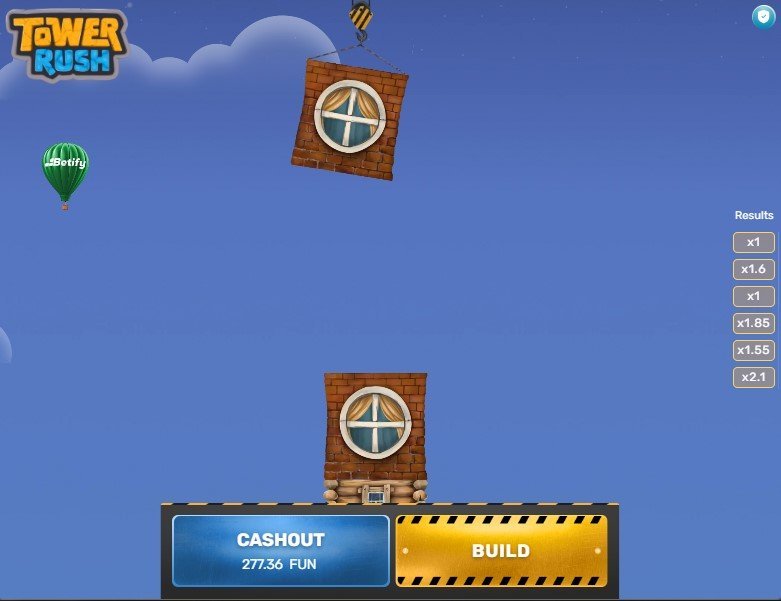
The demo version is directly accessible on the Galaxsys website. No need to create an account, no need to provide an email. Just load the page, play with virtual FUN credits, and that's it.
Everything is identical to the real money version. The bonuses, the physics of the blocks, the multiplier progression. The only difference, of course: the winnings are not real.
I spent a good hour in demo mode before switching to real money. Enough to understand the basic mechanics, identify the levels where the difficulty increases, and especially to get familiar with the click timing. Because timing is 90% of the game.
Practical advice: use the demo to find your comfort zone. Some players consistently cash out at the 5th floor (around x3–x5). Others push up to the 12th or 15th. Knowing how comfortable you are with taking risks before betting real money helps avoid unpleasant surprises.
Strategic approach and timing management
Let's be clear: no strategy guarantees anything. The game relies on a certified RNG, each round is independent of the previous one. Risk and timing management can structure sessions, nothing more.
The cautious approach is to aim for low multipliers (x2–x5) and consistently cash out. The winnings are modest but regular. Over 20 rounds, you can expect to cash out 12–15 times with this method. The downside: monotony, and net winnings remain low after deducting the casino's margin.
The intermediate approach targets x8–x15. More risk, more frequent lost rounds, but more interesting individual winnings. Most regular players position themselves in this zone, from what I've observed.
The aggressive approach aims for x20 and beyond. You accept finishing many rounds at zero to hit a big multiplier from time to time. This approach requires a larger budget and a good tolerance for variance.
My personal setting after about thirty sessions: cashing out between the 7th and 10th floor depending on the moment's feeling. No fixed rule, sometimes the round feels good, sometimes I prefer to secure early.
| Approach | Targeted Floors | Multiplier | Estimated Success Rate | Player Profile |
|---|---|---|---|---|
| Cautious | 3rd–5th | x2–x5 | ~70% | Limited bankroll |
| Intermediate | 7th–10th | x6–x15 | ~45–50% | Regular player |
| Aggressive | 12th+ | x20+ | ~20–30% | High tolerance for variance |
Fairness and security: is the game reliable?
Tower Rush operates with a certified RNG (random number generator) system. Each round produces a verifiable cryptographic hash. The player can verify afterward that the result has not been manipulated.
Galaxsys is a publisher present on many licensed platforms internationally. The game is audited by independent laboratories, the industry standard for crash games.
Does that guarantee a win? No. The casino maintains a mathematical edge in the long run, just like all games of chance. What it guarantees: the results are not rigged. Each round is random, independent, and verifiable.
How does it perform on mobile?
Tower Rush runs in HTML5, so no app to download. You open the phone's browser, go to the casino, and launch the game. That's it.
On a Samsung Galaxy S23, the game loads in a few seconds and runs smoothly. The interface adapts well to the touchscreen, and the buttons are large enough to avoid misclicks during gameplay.
Where it gets tricky: beyond the 10th floor. The block moves quickly, and the precision of your thumb on a 6-inch screen doesn't match that of a mouse. I missed blocks on mobile that I would have placed easily on a computer. It's not a flaw of the game itself, but it's something to keep in mind if you primarily play on your phone.
Data consumption remains light. It won't blow up a data plan, even during a 30-minute session on 4G.
| Criteria | Desktop (mouse) | Mobile (thumb) |
|---|---|---|
| Precision floors 1–8 | Excellent | Good |
| Precision floors 9–12 | Very good | Average |
| Precision floors 13+ | Good | Difficult |
| Loading time | 2–3 seconds | 3–5 seconds |
| Comfort for long sessions | High | Moderate |
Playing for real money: what you need to know before starting
Switching to the paid mode requires choosing an online casino that offers Tower Rush in its catalog. Galaxsys is available at many international operators with recognized licenses (Malta, Curaçao, Gibraltar mainly).
Check the casino's license before making a deposit. That's basic. This information is usually found at the bottom of the site. No license displayed = no deposit.
The registration process is standard: identity, email, password. The first withdrawal triggers a KYC verification (ID, proof of address). It's normal and regulated, expect between 24 and 72 hours depending on the platforms.
Regarding payment methods, most casinos offering Tower Rush accept credit cards, e-wallets (Skrill, Neteller), and sometimes cryptocurrencies. The minimum deposit varies by operator, often ranging from €10 to €20.
Frequently asked questions about Tower Rush
Yes. The demo version is accessible without registration on the Galaxsys site. Virtual credits are unlimited, and the gameplay remains the same as the paid version.
The cap is set at €10,000 or x100 the initial bet, whichever is reached first. With a bet of €100, the theoretical maximum is therefore €10,000.
Yes, via the browser. No app to install. The game runs in HTML5 on any recent smartphone.
Each round generates a cryptographic hash that the player can verify afterward. The Provably Fair system, the standard in crash games.
No. Each block must be placed manually. No auto-play or automatic cashout.
My verdict on Tower Rush
After a good thirty sessions spread over three weeks, Tower Rush holds up well. The active mechanic sets it apart from crash games where you watch a curve rise. Here, each level requires a precise click, and the pressure builds gradually.
The bonuses are decent without being spectacular. The RTP is above average for the genre. The mobile version works well, although precision suffers a bit on higher levels. The demo mode allows you to test without pressure before getting serious.
The weak point? Repetitiveness over long sessions. The gameplay remains the same round after round, and without the variety that more frequent bonuses would bring, fatigue can set in after 40–45 minutes.
Note:4,2/5
A good crash game, well-designed, with a mechanic that requires precision. It's not a game that will change your life, but it's a solid title in its genre. The demo is free, so you might as well take advantage of it to form an opinion.
The payout rate, in plain terms
The RTP announced by Galaxsys is between 96.12% and 97%. In simple terms, for every €100 wagered over the very long term, the game returns between €96.12 and €97. The casino keeps the rest.
We're in the high range for a crash game. For comparison, many classic slots hover around 94–95%. Tower Rush does better, but that doesn't guarantee anything for a given session (the variance remains high). The payout mechanism is still decent.
One important detail: the RTP varies according to player behavior. Someone who cashes out early each round will have a different effective RTP than someone who consistently pushes for high multipliers. The announced figure is a theoretical average over millions of rounds.
What players think about it
★★★★☆ "I've been playing since January on my iPhone 15 Pro. The game is engaging, especially when you start mastering the timing of the blocks. The only downside: the bonuses appear too rarely for my taste. I might have done 60 rounds before seeing my first Frozen Floor." — John D., Bordeaux, January 2026, 4/5
★★★★★ "The first crash game where I feel like I'm controlling something. Slots are pure passivity. Here, every click counts. However, on mobile in the subway, it gets tense after the 8th level due to the bumps." — Sarah L., Paris, February 2026, 4.5/5
★★★★☆ "Good for a crash game. The RTP is solid, the interface is clean. What I like less is the lack of an auto mode. I understand why, but sometimes I just want to let it run." — Ryan M., Lyon, March 2026, 4/5
★★★☆☆ "Honestly, I didn't get hooked at first. It takes 15–20 minutes to grasp the rhythm. After that, it becomes addictive... maybe too much. I now set a limit of 20 minutes per session." — Sophie L., Nantes, February 2026, 3.5/5
Mental fatigue and responsible gaming
One point that isn't mentioned enough. Tower Rush moves quickly. Rounds last between 15 seconds and a minute. In 30 minutes, you can play 30 to 50 rounds. The concentration needed to place the blocks tires the brain faster than you think.
After 20–25 minutes, I noticed my accuracy dropping. Mistakes on the 6th or 7th floor (normally easy floors) started to appear. A clear signal to take a break.
Some common-sense guidelines: set a session budget before starting, never try to "get back" after a series of failed rounds, and accept that variance is part of the game. Timing guarantees nothing when the RNG decides the round ends.
For French players, the Players Info Service (0 974 75 13 13) offers free and confidential support.